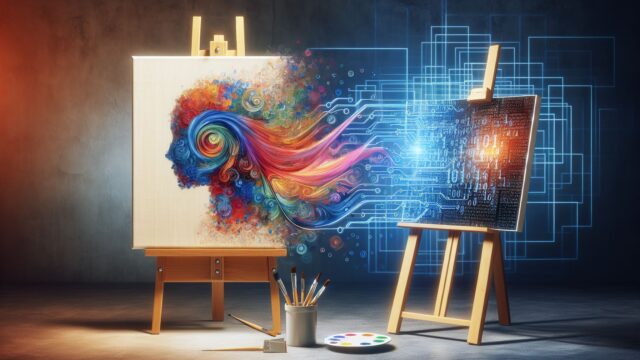
Welcome back to our daily tech talk, where engineering meets imagination. Today I’m looking at artificial intelligence as it crashes into the art world, completely changing how we think about creativity. I’m focusing on AI art here, made not by human hands or inspiration, but by algorithms and neural networks. This is creativity’s new frontier.
The Dawn of AI in Art
Artificial Intelligence has quietly slipped into the art world with tools like DeepArt, NightCafe, and more recently, DALL-E 2. The concept is straightforward: feed a neural network thousands of images packed with data to train algorithms that can create completely new artworks from scratch. Simple idea, incredibly complex execution.
But let’s look beyond just how it started. Which AI art pieces are actually impressing critics and audiences today? Using massive datasets, AI systems create works so convincing that traditional artists might wonder if their craft is becoming obsolete.
When machine creativity produces results that rival human intellect, it raises some serious questions. Are we watching brilliant innovation, or are we reducing artists to outdated relics playing melodies on emotionless machines? This sparks a heated debate about whether conscious, emotional art can survive in an age of calculated creativity. Artists across different platforms are wrestling with how to stay relevant while these AI systems pump out impressive work at lightning speed.
AI-driven Artistic Inspirations
These AI systems are creating work that challenges everything we thought we knew about artistic inspiration. They’re not just copying existing styles but actually developing new approaches that blend techniques in ways human artists never considered. The results can be surprisingly emotional, even though they come from pure logic and data processing.
What’s fascinating is watching how these tools are being adopted by working artists. Some see them as sophisticated brushes, others as collaborators, and some as threats to their livelihood. The reality probably falls somewhere in between. These systems excel at certain types of visual problem-solving but still lack the lived experience that drives truly personal artistic expression.
Realigning Notions of Creativity
Critics are split on what this all means for creativity itself. Some argue that if a machine can produce something beautiful or moving, does it matter how it was made? Others insist that without human experience, emotion, and intention behind it, we’re looking at sophisticated mimicry rather than true art.
I think the most interesting development is seeing human artists learn to work with these tools rather than compete against them. The best AI-assisted art I’ve seen comes from artists who understand both the capabilities and limitations of these systems. They’re using AI to explore ideas they couldn’t execute otherwise, while bringing their own vision and curation to the process.
Reconciling Humanity and Machine Potential
The tension between human creativity and machine capability isn’t going away anytime soon. What we’re seeing is a new creative landscape where the most exciting work often combines human insight with machine processing power. Artists who embrace this hybrid approach are finding ways to amplify their creative voice rather than replace it.
The question isn’t whether AI will change art, it already has. The real question is how artists, critics, and audiences will adapt to this new reality. From what I’ve observed, the most successful approach involves treating AI as a powerful tool that requires skill and vision to use effectively, rather than as either a magic solution or an existential threat.