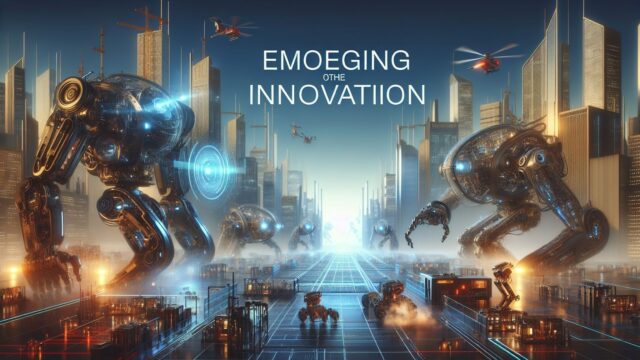
Welcome back, fellow tech aficionados and curious minds! Today, we’re diving down the rabbit hole of emerging technologies with an emphatic nod to robotics—a universe where what was once pie-in-the-sky has rapidly descended to ground-level reality. From surgical bots styled after Swiss watches to warehouse gecko-‘bots doing the heavy lifting, today’s robotics scene is packed with promise and near-futuristic wonders.
When headlines talk about cobots dancing alongside human pals or drones adapting to environmental shifts like seasoned mountaineers, you know something big is happening. The world of robotics has leaped dramatically thanks to advances in artificial intelligence, better IoT integration, and ever-innovative startups disrupting the status quo. Whether you’re nervous about its transformative pace or welcome the almost utopian possibilities we’re seeing in this fourth industrial revolution, the discussion is irresistible. Grab yourself a cup of coffee (or tea), and let’s unravel why robotics is reshaping our world as we know it.
The Current Robotics Panorama: Past Futuristic “Her” to Present Reality
Remember Samantha? No, not your college breakup story—I’m talking about the emotively gripping AI from Spike Jonze’s “Her”. That movie was just one of many creative attempts the past few decades have made to predict our tech-infused future. Back then, such intelligent machinery seemed years, if not decades away. Fast forward to 2023, and those predictions feel almost quaint. The robotics sector has moved from science fiction dreams to machines that perform with immense precision and surprisingly human-like gestures.
A Symphony of Collaboration: Cobots Working Hand in Glove
Here’s what’s interesting: coexistence turned out to be less scary than we thought. Enter cobots, or collaborative robots, which even skeptics admit are increasing productivity while working shoulder to shoulder with human workers. Sectors like manufacturing, once worried about robot takeovers, now voice fewer objections as companies like Universal Robots and Rethink Robotics focus on safety and ease-of-use rather than replacement.
So why should you care? Cobots are changing how we think about automation. Instead of replacing human workers entirely, they’re handling the repetitive, dangerous, or precision-heavy tasks that humans would rather avoid. This means workers can focus on more creative, strategic work while the robots handle the heavy lifting.
You’ll find these machines everywhere now—from supply chain facilities where they’re sorting packages to Ford’s assembly lines where they’re working alongside human technicians. These cobots prove that collaboration, not competition, might be the future of work.
Home Sweet Domestic Automata: Stepping Inside a Smart Home
We’ve all dreamed of robot helpers taking care of household chores, and that future is arriving faster than expected. Sure, your Roomba might still get stuck under the couch occasionally, but today’s domestic robots are getting seriously smart. They’re learning your habits, mapping your space, and even anticipating what you need.
The real excitement isn’t just in the cleaning robots anymore. We’re seeing cooking assistants, garden maintenance bots, and even robots that can help with elderly care. Companies are designing these machines to integrate naturally into our daily routines rather than feeling like intrusive gadgets. Though I’ll admit, there’s still something slightly surreal about asking a robot to vacuum while you’re working from home.
Farm Tech: Where Robots Meet Agriculture
Agriculture might not be the first place you’d expect a robot revolution, but it’s happening. Farm robots are now planting seeds, monitoring crop health, and even harvesting produce with precision that human hands can’t match. These aren’t just massive industrial machines either—some are small, solar-powered units that can work around the clock.
What’s compelling about agricultural robotics is how it’s solving real problems. Labor shortages, the need for sustainable farming practices, and pressure to increase yields are all driving innovation. Robots can work in conditions that would be difficult for humans and collect data that helps farmers make better decisions about everything from irrigation to pest control.
The Road Ahead: What This All Means
Looking at where robotics is heading, I’m honestly both excited and a little overwhelmed. The technology is advancing so quickly that what seems impossible today might be routine next year. But here’s what I find most encouraging: the focus seems to be shifting toward robots that enhance human capability rather than simply replacing us.
That said, we’re definitely going to need to think carefully about how we integrate these technologies. Questions about job displacement, privacy, and even what it means to be human in a robot-filled world aren’t going away. But if the current trends continue, we might just be building a future where robots handle the tasks we’d rather not do, leaving us free to focus on the work that actually matters to us.