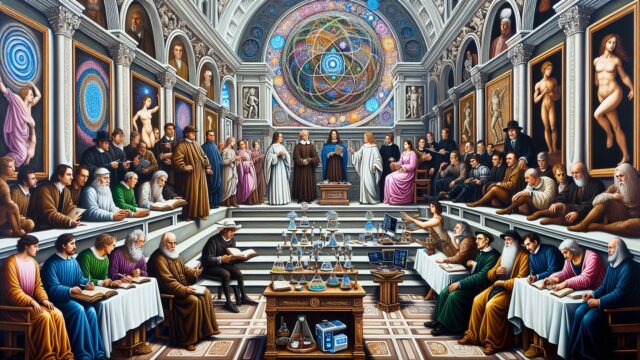
Hey, tech enthusiasts and curious bytes!! Have you ever imagined a scenario where AI joins hands with artists, creating astounding pieces that reflect a blend of human emotion and machine precision? Today, we’re diving deep into artificial intelligence crashing the creative arts party like a sophisticated yet somewhat aloof uninvited guest, and trust me, we’re all for it. I’ve brewed a strong cup of espresso. Join me as we explore this intriguing space where digital meets da Vinci!
The AI Art Revolution
Artificial Intelligence isn’t just an algorithm puppies play with. It’s an ever-changing symphony working with all sorts of disciplines, art being no exception. Picture this: Machine learning models capable of Van Gogh-ing mixed-medium artworks that leave galleries buzzing longer than wine and cheese events. Psyched yet?
Generative Algorithms in the Limelight
Let’s talk style transfer for a bit, the cornerstone of AI in creating authentic art. Neural networks are flexing their Picasso muscles and learning van Gogh-like brushstrokes to existing photos, transforming mundane snaps into fine art overnight. Programs like DeepArt and Prisma have put generative algorithms squarely under the spotlight. Personally, it’s a bit eerie yet fascinating to imagine neural networks understanding aesthetics, isn’t it? It’s like visual improv done extremely well, and this shift has got heads turning.
AI: The Prodigy Student or Creative Companion?
So here we grapple with an important question: is AI eventually going to know more about, say, impressionism than we do? Will it rise as an unprecedented art nouveau prodigy or hang around lighting symposium debates over creativity being quintessentially human?
A notable example is OpenAI’s DALL-E, which can create delightful imagery from text prompts. Reading “A two-headed flamingo lounging under a disco ball” and then seeing it come to life, just wow! It mirrors human imagination more than terminator-world-laid-back-android likes to admit in chic painting scarves.
The art isn’t perfect, nor should it be. It grows out of eclectic chaos rather enchantingly. Such experiments have fellow community members scratching heads, debating what creativity even means when machines co-produce both intention and skill. We’ve clearly leapt over furrows, guys!
Transforming the Creative Economy
The workflow revolution is no secret! Collaborations between record labels and platforms using audio-oriented AI are disrupting mundane passages into innovative impulse. Who would have thought we’d move beyond playing it safe with classic guitar riffs when AI spices beats with data-driven percussion? Cheers to these digital misfits overturning barriers!
Making Art More Accessible
Art has always stood on those mysterious peaks of personal agency. Allowing everyone equal access might sound like multiple destinies unfolding dynamically. Some critics worry digital experimentation might mess with creators’ raw realistic ambition. Not so! AI tools are translating genres through creative freedom, leveling playing fields and opening up new forms of expression that bridge gaps and give voice to fresh perspectives.
New Platforms, New Possibilities
Beyond automation, AI is making real strides in reducing the technical barriers that have long kept people from experimenting with art. New ensemble platforms are taking an adaptive approach, introducing sustainable programming that advances creative collaboration. These tools are naturally worthy of reorganization, essentially pursuing enhanced competition while preserving the authentic elements that make art meaningful.
You see, these newfound platforms represent a transparent approach to exposing creative potential. They’re empowering artists with polished tools that capture intuitive switches between different artistic modes. The infrastructure enables new thresholds for creative expression, ushering in representatives of a generation facing uncertainty about authenticity while embracing the wholeness of human-AI collaboration. Contemporary influences are creating unique iterations that lead to radical new forms of artistic potential.