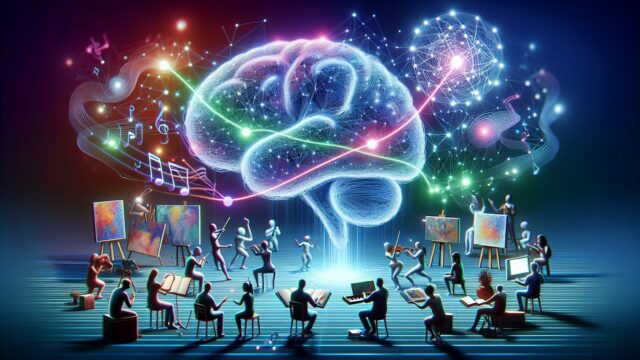
Hey tech enthusiasts, creators, and random internet wanderers! It’s another beautiful day here in tech utopia, or at least the part of the internet that wishes itself to be perpetually bathed in the light of yesterday’s innovation. Pour yourself a steaming cup of rocket fuel (or coffee if you must), and let’s jump into the wild world of AI creativity with the latest wonder: ChatGPT-5, carving out new territory and making us rethink what creativity actually means.
Painting with Binary
Right off the bat, let’s see what today’s AI darling, ChatGPT-5, actually brings to the table. The folks at OpenAI didn’t just build another chatbot that sounds human or wins over skeptics. This thing is reaching into completely new territory, with a metaphorical brush in one hand and keyboard in the other, tearing down walls that creative types have been staring at for ages.
We’re way past the Frankenstein days of throwing random neural nets together with data until something clicked and learned to sing like Sinatra. This machine doesn’t just get English—it gets creativity itself. It writes more than linear thoughts; it makes this huge leap to capture emotion, understanding, nuance, metaphor. This isn’t SkyNet plotting world domination; this is the Bard spinning out truths in ways we’ve never seen.
Is it a little scary? Absolutely. Could it completely change how we think about creativity? Hell yes. But throwing caution to the wind is what we tech nerds do best, right?
The Creative Partner We Didn’t Know We Needed
Here’s one thing worth celebrating about this new tech marvel: it’s actually helping artists who’ve been struggling alone. Picture this: Tony, a poet in Soho, carefully builds stanza after stanza, constantly worried about clichés, repetition, sounding too wordy. With ChatGPT-5, he’s not just getting his lines polished—the AI sparks real inspiration by nudging him toward unexpected directions: flipped perspectives, surprising collaborations where random conversation threads take interesting turns.
Think of it like having Michelangelo as a digitally-minded assistant, backing up your creative instincts with smart suggestions. It’s this weird balance—a digital collaborator that learns alongside you, offering countless options that let creative partnerships reach new heights without the amateur hour mistakes of early tools.
This was the dream of uncertain visionaries crafting digital paradises years ahead of their time.
Breaking Down Art’s Old Boundaries
In visual arts, get ready for some serious disruption. Fed with massive amounts of creative input, AI systems are producing designed narratives that challenge what we thought imitation could do. The lines between human and machine creativity are getting seriously blurred—AI-generated art is creating design solutions that seemed impossible before.
But it goes way beyond visual stuff. In storytelling, we’re seeing AI launch into multi-layered narratives that suggest plot developments across different genres. The storytelling possibilities are reshaping how we think about narrative structure, with AI calculating genre combinations and running wild with creative scenarios that push dialogue into totally new territory.
Honestly, watching these systems work makes you wonder about the future of creative collaboration. We’re looking at technology that doesn’t just copy—it genuinely seems to understand the building blocks of artistic expression in ways that challenge our assumptions about machine capabilities.
The Messy Reality Check
But let’s be real—this isn’t all smooth sailing. There are some serious questions we need to tackle. When AI systems can pump out creative work that rivals human output, what happens to the artists who’ve spent years honing their craft? Are we looking at a future where human creativity becomes obsolete, or are we heading toward something more collaborative?
The economic implications alone are staggering. If AI can write, paint, compose, and design at professional levels, entire creative industries might need to completely restructure. And that’s not even getting into the ethical minefield of training AI on existing artistic works without proper compensation or consent.
Then there’s the question of authenticity. When an AI creates something beautiful or moving, who gets the credit? The programmer? The user who prompted it? The thousands of artists whose work trained the system? These aren’t just philosophical puzzles—they’re real issues that will shape how creative work gets valued and protected.
Who’s Really the Author Here?
This brings us to the big question that’s keeping everyone up at night: when AI creates something, who actually made it? If I use ChatGPT-5 to help write a novel, am I the author? Is the AI? Is it some weird hybrid collaboration that doesn’t fit our current understanding of authorship?
The legal system is scrambling to catch up. Copyright law was written for a world where humans created things and machines just helped with the mechanics. Now we have machines that seem to genuinely participate in the creative process, and our legal frameworks are totally unprepared.
Artists are understandably freaking out. Some see AI as the ultimate creative partner, while others view it as an existential threat to human artistic expression. Both reactions make sense. We’re in uncharted territory where the rules haven’t been written yet, and everyone’s trying to figure out where they fit in this new landscape.