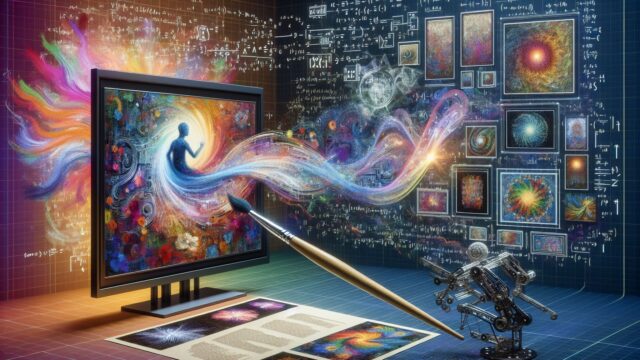
Hey fellow innovators! If you’re reading this, you’re probably just as excited about our tech advances as I am! I pushed my digital boundaries today by exploring how Artificial Intelligence is becoming a real creative powerhouse. AI in the arts? Yeah, let’s dig in and unpack this new frontier that’s sneaking up on human creativity.
Welcome To The Renaissance Redux
Back in the day, great artists like Leonardo da Vinci were scientists and tech enthusiasts rolled into one. Fast forward a few centuries. Artists now have a different, slightly robotic muse—one that lacks traditional flesh and blood—the wild world of Artificial Intelligence. And while these algorithms don’t munch on apples like we do (sips on green smoothie), they’ve developed a digital hunger for creative expression.
The meeting point of art and AI is both amazing and bewildering, honestly. I remember my buddy Arthur—your typical paint-obsessed techno-dreamer—came over last summer to test some AI-generated art theories over cocktails. We fell down a rabbit hole exploring various AI art platforms, complete with enough data and algorithms to blow our minds.
What’s exciting to watch is how this creative shift mirrors periods like the Renaissance, where new techniques and perspectives mixed together to create the styles we now love in art galleries.
The Digital Paintbrush: Artists Fight Back
Alright, now we’re getting into the good stuff! AI doesn’t wear a beret when creating digital masterpieces, but it uses “neural networks”—virtual brain-like systems that would probably impress even the greatest minds of the past.
Let me break down GANs (Generative Adversarial Networks)—the tech that artists use to create through a kind of creative competition. Think of them as two AI systems battling it out, one creating art while the other critiques it until something amazing emerges.
Remember the AI artist “Ai-Da”? This robot has actually created paintings and held exhibitions, challenging what we think art should be. It’s wild to see a machine with robotic arms creating portraits that could hang next to human-made pieces.
But there’s definitely pushback. Many traditional artists worry about being replaced or devalued. I get it—there’s something unsettling about a computer potentially doing what humans have considered uniquely ours for thousands of years.
Curious yet? You should be. These neural networks are learning from millions of artworks and developing their own style.
What’s Really Happening Behind The Scenes
The technical side gets pretty complex. These AI systems analyze patterns, colors, brushstrokes, and compositions from countless paintings. They’re essentially learning the “rules” of art—then breaking them in interesting ways.
I’ve seen AI create everything from photorealistic portraits to abstract pieces that look like they came from another dimension. The variety is honestly staggering. Some pieces feel cold and calculated, others surprisingly emotional.
What fascinates me most is when AI creates something that makes you stop and think. Like, did this machine just express something profound, or am I reading too much into pixels and code?
When Tradition Meets Technology
Here’s where things get really interesting. Some artists are embracing AI as a collaborative tool rather than seeing it as competition. They’re using it to generate ideas, experiment with new styles, or handle tedious parts of their process.
I talked to a painter who uses AI to generate color palettes and rough compositions, then adds her own interpretation and technique. She says it’s like having a creative assistant that never gets tired and always has fresh ideas.
But the art world is still figuring out the ethics. If an AI creates a painting, who owns it? The programmer? The person who prompted it? The AI itself? These aren’t just philosophical questions—they’re affecting real artists’ livelihoods.
Where Do We Go From Here?
I think we’re still in the early days of understanding what AI art means. The technology is improving fast, but the cultural conversation is just beginning.
Some galleries now have dedicated AI art sections. Art schools are adding AI courses. Young artists are growing up with these tools as naturally as previous generations picked up Photoshop.
What excites me most is the possibility of entirely new art forms. We might see interactive pieces that evolve based on viewer reactions, or collaborative works between humans and AI that neither could create alone.
The skeptic in me wonders if we’re losing something essential about human expression. But the tech enthusiast in me can’t wait to see what impossible things become possible.
What do you think? Are you ready to hang an AI-generated piece in your living room, or does the whole thing feel like we’re crossing a line we shouldn’t cross?